Click here to download the Libretto
- Benjamin Britten. Comic opera in three acts. 1947.
- Libretto by Eric Crozier, after Guy de Maupassant’s Le Rosier de Madame Husson (Madame Husson’s Rose-Bush).
- First performance at Glyndebourne on 20th June 1947.
CHARACTERS
| Lady Billows, an elderly autocrat | soprano |
| Florence Pike, her housekeeper | contralto |
| Miss Wordsworth, head teacher | soprano |
| Mr Gedge, the vicar | baritone |
| Mr Upfold, the mayor | tenor |
| Superintendent Budd | bass |
| Sid, a butcher’s boy | baritone |
| Albert Herring, from the greengrocer’s | tenor |
| Nancy, from the bakery | mezzo-soprano |
| Mrs Herring, Albert’s mother | mezzo-soprano |
| Emmie / Cis, village children | soprano |
| Harry, village children | treble |
Lady Billows, the dominant figure in the small Suffolk town of Loxford and self-appointed guardian of public morals, is resolved to find a candidate virtuous enough to occupy the position of May Queen, with the help of the vigilant Florence Pike, who keeps a list of miscreants and misdemeanours, and a committee of local worthies. It is eventually decided that no girl is virtuous enough but that Albert Herring, a backward boy, only son of Mrs Herring, who keeps the greengrocer’s, should be made May King. Sid, the butcher’s boy, suggests that Albert should break free from his mother’s control, and when he and Nancy, from the baker’s, resolve to meet at night, Albert is bound to wonder at what he is missing. The crowning of the new May King is duly carried out, with appropriate presents and comments from the leaders of the community. Sid, however, has laced Albert’s lemonade with rum. After the ceremony Albert, now uninhibited, makes a break for freedom. The next morning his mother is distraught at his absence and is joined by others, lamenting what might well be his early death. Albert reappears, however, free at last, thanks to Sid and Nancy, but presumably no longer fulfilling the exacting moral standards of Lady Billows.
Benjamin Britten’s Albert Herring followed The Rape of Lucretia and was the first work to be written for the newly established English Opera Group, which was responsible for the first performances at Glyndebourne and then at the newly founded Aldeburgh Festival. The score of this second chamber opera is witty and apt in its allusions and parodies, with its use of traditional children’s songs and with more serious elements that raise it to a level of wider significance, notably the threnody on the supposed death of Albert, together with the idea, central to much of Britten’s operatic work, of the destruction of innocence, however lightly it may be treated here.
![BRITTEN, B.: Albert Herring [Opera] (Gillett, Barstow, Palmer, D. Jones, Finley, A. Taylor, Gritton, R. Lloyd, Savidge, Northern Sinfonia, Benford)](https://cdn.naxos.com/sharedfiles/images/cds/hires/8.660107-08.jpg "BRITTEN, B.: Albert Herring [Opera] (Gillett, Barstow, Palmer, D. Jones, Finley, A. Taylor, Gritton, R. Lloyd, Savidge, Northern Sinfonia, Benford)")
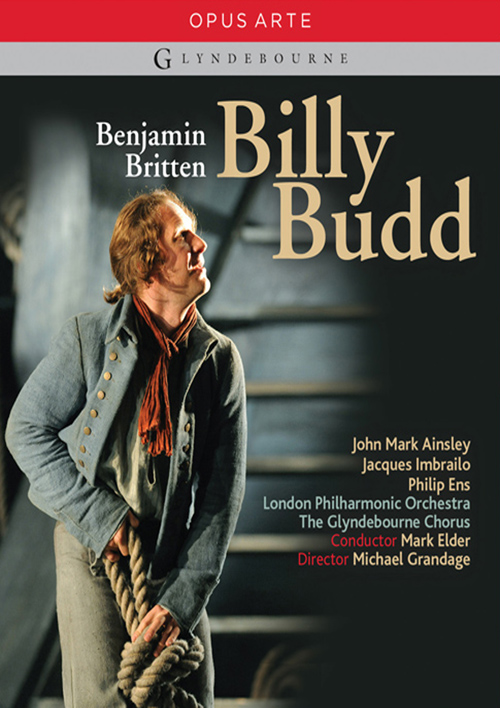
![BRITTEN, B.: Billy Budd [Opera] (Shicoff, Skovhus, Halfvarson, Vienna State Opera Chorus and Orchestra, Runnicles)](https://cdn.naxos.com/sharedfiles/images/cds/hires/c602033d.jpg "BRITTEN, B.: Billy Budd [Opera] (Shicoff, Skovhus, Halfvarson, Vienna State Opera Chorus and Orchestra, Runnicles)")
![BRITTEN, B.: Death in Venice [Opera] (Teatro Real, 2014) (NTSC)](https://cdn.naxos.com/sharedfiles/images/cds/hires/2.110577.jpg "BRITTEN, B.: Death in Venice [Opera] (Teatro Real, 2014) (NTSC)")
![BRITTEN, B.: Rape of Lucretia (The) [Opera] (Glyndebourne, 2015) (NTSC)](https://cdn.naxos.com/sharedfiles/images/cds/hires/oa1219d.jpg "BRITTEN, B.: Rape of Lucretia (The) [Opera] (Glyndebourne, 2015) (NTSC)")
![BRITTEN, B.: Turn of the Screw (The) [Opera] (Langridge, Lott, Pay, Aldeburgh Festival Ensemble, Benford)](https://cdn.naxos.com/sharedfiles/images/cds/hires/8.660109-10.jpg "BRITTEN, B.: Turn of the Screw (The) [Opera] (Langridge, Lott, Pay, Aldeburgh Festival Ensemble, Benford)")